In a land where the Ford F-150 and the Tesla Cybertruck dominate the asphalt, the arrival of a vehicle barely longer than a park bench seems like an automotive punchline. Yet, as American urban centers grapple with unprecedented congestion and the average price of a new electric vehicle (EV) hovers near the $50,000 mark, a "Little Mouse" is preparing to scurry across the Atlantic.
Stellantis has confirmed that the Fiat Topolino, a European sensation, is slated for a U.S. debut in 2026. With an estimated starting price of $11,500, it represents a radical departure from the "bigger is better" ethos of the American market. On the surface, a vehicle capped at 28 mph sounds absurd for the home of the interstate. But the answer to its viability lies in how Americans actually drive: the Department of Transportation notes that nearly 50% of all vehicle trips in the U.S. are less than three miles.
For the hyper-local commuter, the Topolino isn't just a car; it is a strategic tool designed for "evolution through subtraction."
Quick Specs: The Micro-Mobility Landscape
| Feature | 2026 Fiat Topolino | High-End Golf Cart | Subcompact EV (e.g., Fiat 500e) |
|---|---|---|---|
| Estimated Price | $11,500 | $12,000 - $18,000 | $32,500 |
| Top Speed | 28 mph | 19 - 25 mph | 94 mph |
| Electric Range | 47 miles | 25 - 40 miles | 149 miles |
| Length | 95 inches | ~94 inches | 143 inches |
| Charging | 110V Standard Outlet | 110V Standard Outlet | Level 2 / DC Fast Charge |
The 'Little Mouse' Comes to America: A 2026 Preview
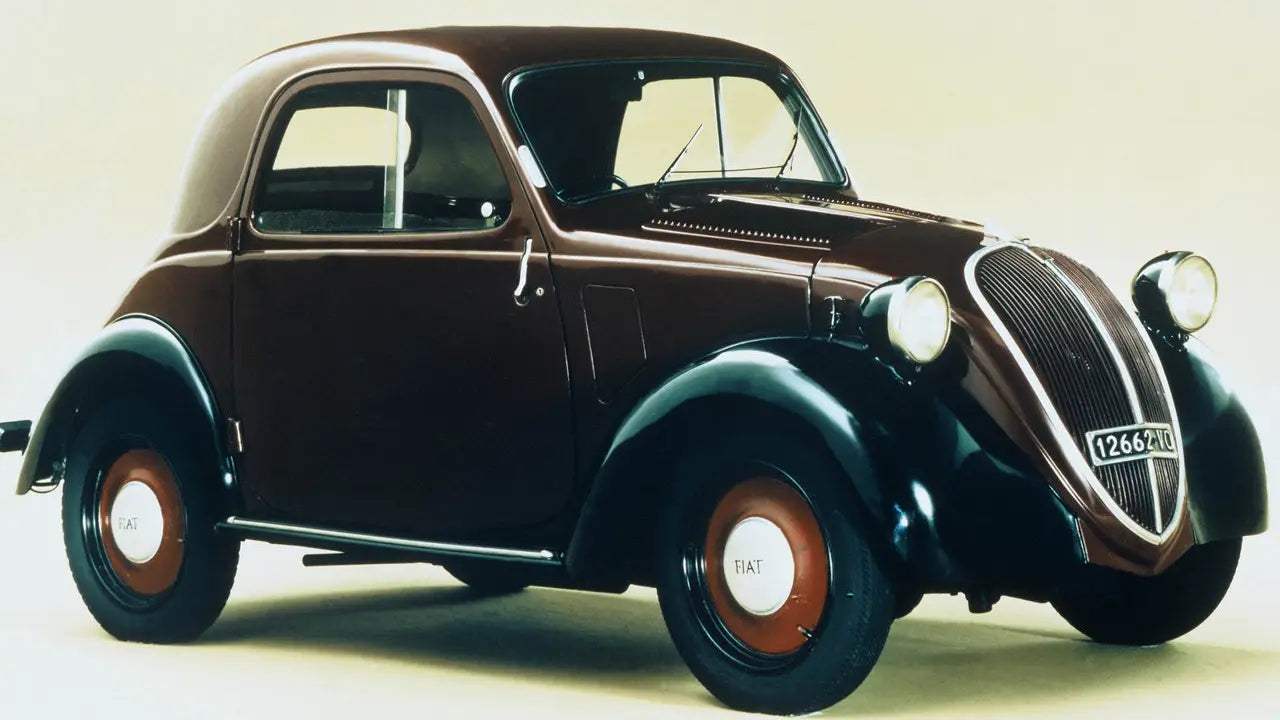
The name "Topolino" translates literally to "Little Mouse," a moniker originally bestowed upon the 1936 Fiat 500. That car was credited with putting Italy on wheels, offering affordable mobility during a period of economic transition. The 2026 iteration aims to perform a similar feat for the electric era, though its mission is strictly localized.
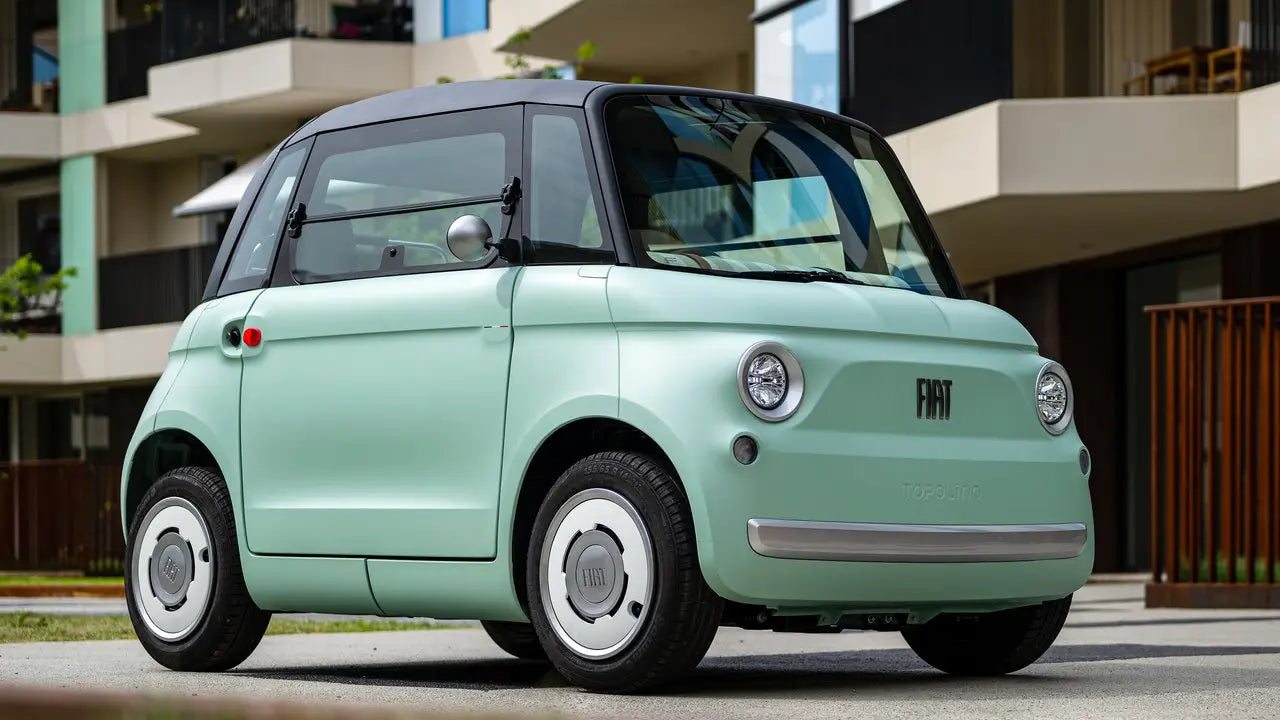
As a travel critic who has navigated the narrow cobblestones of Rome and the sprawling boulevards of Miami, I view the Topolino as a bridge between two worlds. It is classified as a Low-Speed Vehicle (LSV) or Neighborhood Electric Vehicle (NEV). This means it bypasses many of the complex (and expensive) crash-test requirements of full-sized passenger cars, allowing Fiat to hit that remarkably low $11,500 price point—roughly 65% lower than the Fiat 500e.
2026 Fiat Topolino Specs: Small Battery, Big Efficiency
The technical architecture of the Topolino is a masterclass in minimalism. It is powered by a modest 5.5 kWh lithium-ion battery paired with an 8-hp motor. While these numbers might seem diminutive, they are perfectly calibrated for the vehicle's 1,000-pound curb weight.
- Range & Speed: You can expect a 47-mile range on a single charge. In an urban environment where the average commute is under 10 miles, this provides several days of utility between charges. However, the hardware is electronically governed to a top speed of 28 mph, ensuring it remains within legal LSV parameters.
- Charging Simplicity: Perhaps its greatest "luxury" is the lack of specialized infrastructure. The Topolino features a built-in cable that plugs directly into a standard 110V household power outlet. There is no need for a $1,000 home charger installation; simply plug it in like a smartphone, and you will have a full charge in approximately 4 to 6 hours.
- Dimensions: Measuring only 95 inches in length, the Topolino is 40% shorter than a typical subcompact car. In dense urban cores like Charleston, Manhattan, or San Francisco, this allows for "nose-in" parking in spaces that a standard sedan would have to bypass.

The Budget Comparison: How It Stacks Up
When evaluating the Topolino, one must resist the urge to compare it to a Tesla Model 3 or a Hyundai Ioniq. Its true competitors are the Vinfast VF3 (targeting a ~$10,000 price point) and high-end street-legal golf carts from brands like Garia or Club Car.
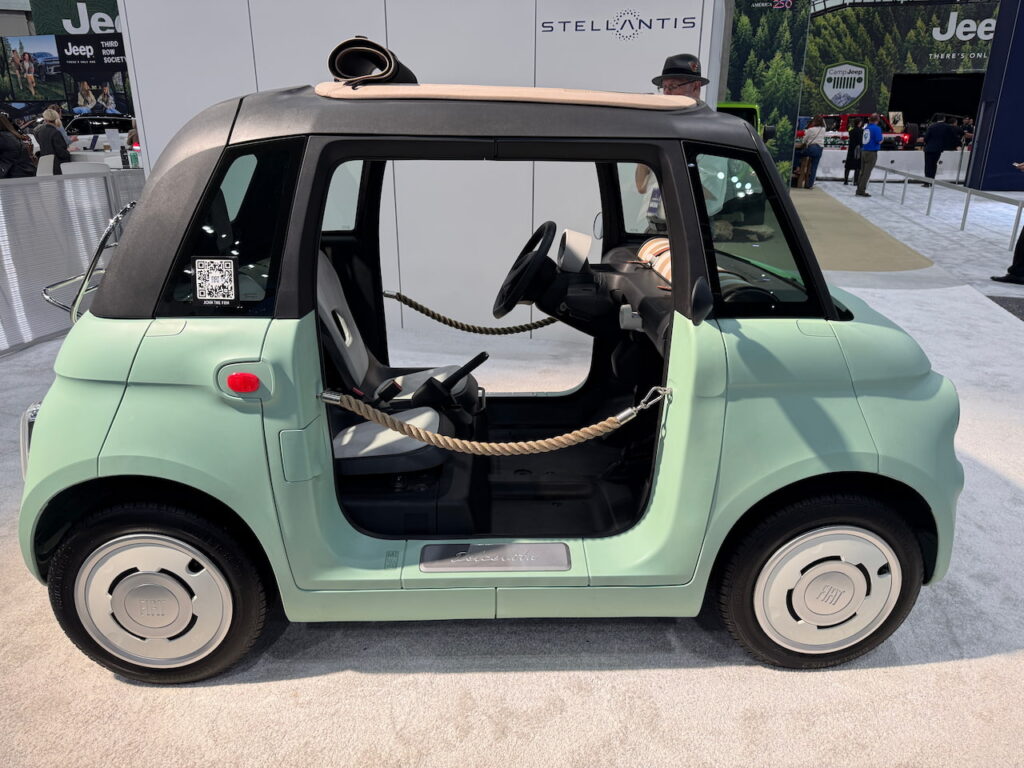
At an estimated $11,500, the Topolino offers something a golf cart cannot: Italian style and enclosed weather protection. For those seeking the ultimate "resort" aesthetic, Fiat will offer the 'Dolcevita' version, which replaces the doors with braided ropes and adds a vintage-style roll-back fabric roof.
The maintenance profile is equally attractive. With fewer moving parts than even a standard EV—no power steering pumps, no complex infotainment cooling systems, and tiny tires—the cost per mile is expected to be the lowest of any four-wheeled vehicle in the United States.
Use Cases: Who is the Topolino Actually For?
The skepticism surrounding the Topolino usually stems from a misunderstanding of its purpose. It is not a replacement for the primary family SUV; it is a replacement for the second car that currently spends 90% of its time idling in traffic or running half-mile errands.
- The Island & Beach Town Commuter: In places like Martha's Vineyard, Key West, or Newport Beach, high speeds are non-existent and parking is at a premium. The Topolino excels here.
- Gated & Retirement Communities: For residents of The Villages or similar planned communities, the Topolino offers a safer, more stylish alternative to the traditional golf cart.
- The 'Last Mile' Urbanite: For those living in downtown lofts who only need to reach the grocery store, the gym, or the local café, the Topolino provides a weather-sealed, lockable solution that an e-bike cannot match.
The Reality Check: Legal Classification and Safety
We must be objective: the Topolino comes with significant caveats. Because it is an LSV, federal law prohibits it from being driven on roads with speed limits exceeding 35 mph. This effectively bans it from all highways and most major suburban arteries. If your daily route requires a "stint on the 405," the Topolino is a non-starter.
Furthermore, there is the "physics problem." In a collision with a 6,000-pound SUV, a 1,000-pound quadricycle is at a massive disadvantage. While it includes basic safety features like seatbelts and a sturdy frame, it does not possess the array of airbags or crumple zones found in a standard passenger car.
Regarding licensing, most U.S. states will require a standard driver's license to operate an LSV on public roads, though insurance premiums are typically significantly lower than those for full-sized vehicles.

Conclusion: Can America Embrace Micro-Mobility?
The Fiat Topolino is a litmus test for the American consumer. It challenges the notion that we need two tons of steel and a 300-mile range to pick up a gallon of milk. It is a niche product, certainly, but it is a niche that is growing as "15-minute city" urban planning gains traction.
As a critic, I find the Topolino's honesty refreshing. It doesn't pretend to be a grand tourer. It is a purpose-built tool for the "last mile," wrapped in a package that brings a sense of joy and Italian "La Dolce Vita" to the mundane task of local transit. If you can live within the 28 mph bubble, it may well be the smartest $11,500 investment in your garage.
FAQ
Q: Can I drive the Fiat Topolino on the highway?
A: No. As a Low-Speed Vehicle (LSV), the Topolino is legally restricted to streets with posted speed limits of 35 mph or less. It is strictly for local, neighborhood, and urban use.
Q: Do I need a special charging station at home?
A: No. The Topolino is designed to charge using a standard 110V household outlet. It can reach a full charge overnight (approx. 4-6 hours) without any specialized equipment.
Q: Will it be eligible for the $7,500 federal EV tax credit?
A: Likely not. Most federal EV tax credits apply specifically to "four-wheeled plug-in electric drive vehicles" that meet full Federal Motor Vehicle Safety Standards (FMVSS). LSVs typically do not qualify for the full credit, though some state-level incentives for micro-mobility may apply.
Ready to rethink your local commute?
Stay updated on the latest micro-mobility news and the official 2026 release date for the U.S. market.