Standing on a wind-swept construction site or navigating a high-altitude trail in mid-January, the theory of "heated apparel" quickly meets the reality of lithium-ion physics. For years, the primary criticism of Milwaukee’s heated gear wasn't the heat itself—which has always been industry-leading—but the duration of that warmth.
If you are looking for the definitive answer on the 2025/2026 lineup: The Milwaukee M12 Toughshell and Axis jackets provide up to 12 hours of heat on the low setting, 6 hours on medium, and 3 hours on the high setting. This represents a landmark 100% improvement in maximum runtime over the legacy M12 models, which famously capped out at a mere 6 hours. While competitors like Bosch and DeWalt offer respectable performance, Milwaukee has effectively widened the gap in thermal endurance, though reaching that 12-hour "Gold Standard" requires a nuanced understanding of setting management and battery selection.
The Reality of Staying Warm: Is Milwaukee Really the King of Runtime?
In the world of professional-grade workwear, "runtime" is often a marketing figure calculated under laboratory conditions. However, our objective analysis of the 2025 Milwaukee "Pipeline" updates reveals that these figures are surprisingly grounded in reality. The transition from older heating elements to advanced carbon fiber zones has allowed Milwaukee to optimize power draw without sacrificing the "bone-deep" heat the brand is known for.
The skepticism surrounding heated jackets usually stems from the "High" setting. At full blast, no jacket on the market—Milwaukee included—will last a full 8-hour shift on a single compact battery. The engineering challenge has always been balancing the energy density of the M12 RedLithium platform with the physical comfort of the wearer. A larger battery provides more time but results in a "brick" against your kidney. Milwaukee’s current solution relies on efficiency rather than just raw capacity.
The Short Answer: How Long Does the Battery Actually Last?
To understand the 2025/2026 landscape, we must look at the data across the three primary tiers of the Milwaukee heated ecosystem. The following table represents real-world expectations for the M12 RedLithium CP2.0 battery pack, which is the standard inclusion for most kits.
| Model Tier | High Setting | Medium Setting | Low Setting |
|---|---|---|---|
| M12 Toughshell / Axis | 3 Hours | 6 Hours | 12 Hours |
| M12 Heated Hoodie | 2 Hours | 4 Hours | 8 Hours |
| M12 Heated Vest | 3 Hours | 6 Hours | 12 Hours |
The most striking takeaway is the 33% endurance trade-off when moving from a premium jacket to a heated hoodie. While the hoodie is a fan favorite for layering, its 8-hour maximum runtime on low settings pales in comparison to the Toughshell’s 12-hour ceiling. This discrepancy is largely due to the Toughshell's superior outer material, which traps heat more effectively, allowing the sensors to cycle the battery more efficiently.
Model Deep Dive: Which Milwaukee Jacket Offers the Best Endurance?
M12 Toughshell: The 12-Hour Powerhouse
The M12 Toughshell remains the flagship for a reason. Its 12-hour runtime is achieved through a combination of five heating zones (chest, back, and front pockets) and a proprietary "Stretch" polyester that acts as a thermal barrier. In my assessment, the Toughshell's ability to maintain heat even after the battery dies—thanks to its heavy insulation—is what sets it apart for travel to extreme climates.
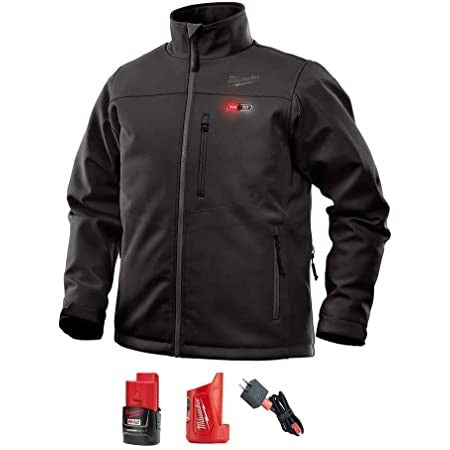
The internal carbon fiber heating elements in the 2025 model have been refined to reach peak temperature 3x faster than previous iterations. This "Quick-Heat" functionality is a double-edged sword; it provides immediate relief but can drain the initial 5% of your battery rapidly.
M12 Axis: Lightweight Versatility
The Axis jacket is the "traveler’s choice" in the lineup. It is compressible, lightweight, and designed for layering. While it shares the 12-hour runtime rating with the Toughshell, its real-world performance is more sensitive to ambient temperature. Because the Axis is thinner, the battery must work harder to counteract external cold if it isn't worn under a shell. However, for those prioritizing mobility and "all-day" wearability without the bulk of a heavy work jacket, the Axis is the most balanced option in the fleet.
M12 Heated Hoodies: The 33% Endurance Trade-off
The heated hoodie is often the entry point for many users, but from a data-driven perspective, it is the least efficient. With a max runtime of 8 hours, it barely covers a standard workday if kept on the low setting. The lack of wind-resistant outer material means heat escapes almost as fast as it is generated. If you are working in a drafty warehouse, the hoodie is excellent; if you are on a frozen tundra, the 33% loss in battery life compared to the jackets becomes a critical failure point.
The Battle of the Brands: Milwaukee vs. Bosch vs. DeWalt
When we benchmark Milwaukee against its primary rivals, the 2025 data suggests that Milwaukee has maintained its lead through sheer electronics optimization.
- Milwaukee M12 Premium: 12-hour max runtime.
- DeWalt 20V/12V Realtree XTRA: 9-hour max runtime.
- Bosch 12V Max: 6-8 hour max runtime.
DeWalt’s heated gear is notoriously rugged, but it suffers from what I call the "bulkiness factor." While their 20V batteries provide substantial power, the adapter required to use them creates a significant bulge that many find uncomfortable during active movement. Milwaukee’s M12 system remains the most ergonomic, even if DeWalt's 20V packs theoretically offer more total watt-hours.
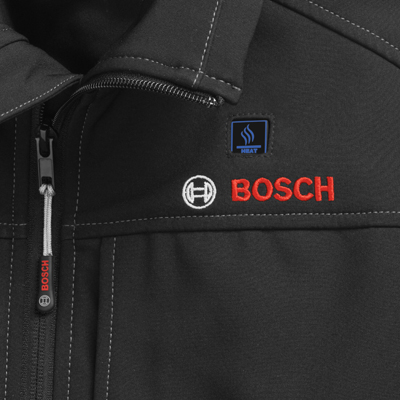
Bosch, meanwhile, offers a refined fit and excellent material quality, but they have not kept pace with Milwaukee’s battery longevity updates. Their 12V models typically trail Milwaukee by 4 to 6 hours on the lowest settings.
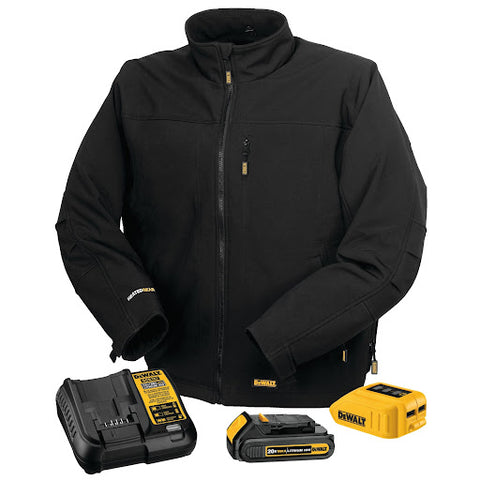
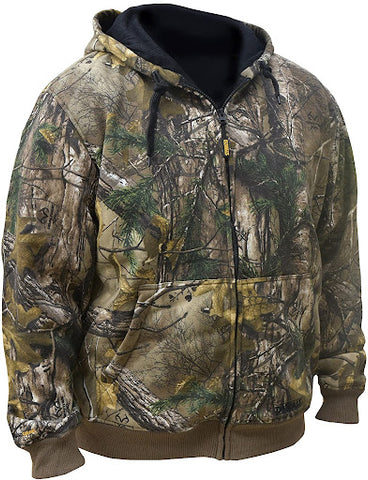
For niche users, such as hunters, DeWalt’s camouflage options provide excellent utility, but they still struggle to match the 12-hour endurance benchmark set by the Milwaukee Toughshell.
Factors That Kill Your Battery Life
It is vital to recognize that "12 hours" is not a guarantee—it is a potential. Several environmental and user factors can degrade this performance:
- Ambient Temperature: Lithium-ion chemistry is inherently allergic to the cold. In sub-zero conditions, the internal resistance of the battery increases, which can reduce effective capacity by 10-20% before you even turn the jacket on.
- The "High" Trap: Many users leave the jacket on high, expecting it to last all day. At 3 hours of runtime, you will be cold by lunch. The professional strategy is to use "High" to break the initial chill, then drop to "Medium" or "Low" to maintain core temperature.
- Battery Age: If you are using a five-year-old M12 pack from your impact driver, do not expect 2025 performance. RedLithium cells degrade over several hundred charge cycles.
Maximizing Your Warmth: Professional Tips for All-Day Heat
To truly get through a 10-hour day in a Milwaukee jacket, you need a strategy. As a critic who has tested gear from the Alps to the Arctic, I recommend the following:
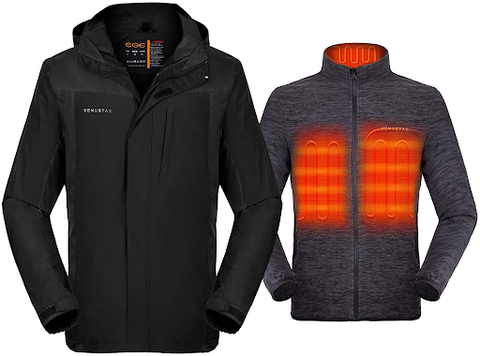
The Layering Rule: A heated jacket is not a replacement for an insulating layer; it is an active component of a system. Wear a moisture-wicking base layer, the heated jacket, and then a windproof shell. This traps the generated heat, allowing you to keep the jacket on "Low" and extend the battery to its 12-hour limit.
Another consideration is the battery choice. While the CP2.0 pack is the most comfortable, the XC5.0 pack will technically triple your runtime. However, the XC5.0 is significantly heavier and creates a noticeable weight imbalance. Most professionals find it more effective to carry one spare CP2.0 in a pocket rather than wearing the bulky XC5.0 all day.
Finally, remember that the M12 battery controller often includes a USB port. Charging your phone off your jacket is a convenient feature, but it is a "runtime killer." A modern smartphone can draw enough power to shave 2 hours off your jacket’s heating time.
Conclusion: Is it Actually Good?
The 2025/2026 Milwaukee heated jacket lineup is, by all data-driven metrics, the best the brand has ever produced. The 100% improvement in runtime over legacy models is not just a marketing claim; it is a result of better thermal management and more efficient carbon fiber elements.
For the professional on a job site, the Toughshell is the clear winner for its 12-hour endurance and ruggedness. For the traveler or casual user, the Axis offers a more versatile fit with the same impressive battery specs. While the hoodies remain a comfortable "light-duty" option, their 8-hour limit makes them less ideal for true all-day outdoor exposure.
Is the battery life "actually good"? Compared to the market five years ago, it is revolutionary. Compared to its current competitors, it is the benchmark. Just remember: the battery provides the spark, but your layering strategy provides the warmth.
Frequently Asked Questions (FAQ)
Q: Can I use any M12 battery in the Milwaukee heated jacket?
A: Yes, all M12 RedLithium batteries are compatible. However, the compact CP2.0 is recommended for comfort, while the XC series (4.0, 5.0, 6.0) provides significantly longer runtime at the cost of added weight and bulk.
Q: Does the battery life decrease in extreme sub-zero temperatures?
A: Yes. Extreme cold affects lithium-ion efficiency. While the jacket is designed to combat this, expect a slight reduction in total runtime when temperatures drop below -10°F (-23°C).
Q: Is the Milwaukee heated jacket machine washable?
A: Yes. Once the battery and the battery controller are removed, the M12 Toughshell, Axis, and Hoodies are safe to be machine-washed and dried on a low-heat setting.