Think of your refrigerator as more than just a place to keep your milk cold and your beer chilled. From my perspective as a smart home editor, it is the most sophisticated piece of safety equipment in your kitchen. Yet, most of us treat it as a "set it and forget it" appliance. The reality is far more sobering: the FDA estimates that foodborne illnesses affect 48 million people in the U.S. annually, leading to 128,000 hospitalizations and 3,000 deaths.
Many of these cases are entirely preventable by adjusting a single setting. An EU-wide study revealed that the average domestic refrigerator temperature is 43.52°F (6.4°C)—staggeringly higher than the maximum recommended safety limit of 40°F. This gap between "cold enough" and "safely cold" is where pathogenic bacteria thrive.
The Golden Number: What is the Ideal Refrigerator Temperature?
When you look at the dial or digital readout on your fridge, you aren't just looking at a comfort setting; you're looking at a microbial barrier. To keep food safe, the FDA mandates a temperature of 40°F (4°C) or below. However, as someone who tests smart home sensors for a living, I recommend a slightly tighter margin.
Most experts, including those at Consumer Reports, suggest a "sweet spot" of 37°F (3°C). This lower setting provides a critical buffer. If you open the door frequently to grab snacks or if the ambient kitchen temperature rises during a summer heatwave, a starting point of 37°F ensures that your food remains below the 40°F danger threshold even during minor fluctuations.
| Standard | Recommended Setting | Why it Matters |
|---|---|---|
| FDA Minimum | 40°F (4°C) | The absolute ceiling for food safety; bacteria growth slows significantly. |
| Expert Choice | 37°F (3°C) | Provides a safety margin for door openings and internal hot spots. |
| Freezer Standard | 0°F (-18°C) | Stops all microbial growth and keeps food quality intact for months. |
Maintaining these temperatures isn't just about safety; it’s about food waste. Milk stored at 37°F will often stay fresh days longer than milk stored at 42°F. In the world of home automation, many modern smart fridges now come with "Power Cool" features to rapidly drop temperatures after a large grocery haul—a feature I highly recommend using to stabilize the environment quickly.
Understanding the 'Temperature Danger Zone'
In food safety circles, we talk about the "Danger Zone" with a level of urgency usually reserved for house fires. This zone ranges from 40°F to 140°F (4°C to 60°C). Within this window, pathogenic bacteria like Salmonella, E. coli, and Listeria don't just grow; they explode. Under the right conditions, a single bacterium can double every 20 minutes.
This is why the 2-Hour Rule is the golden law of the kitchen. Perishable foods—think meat, dairy, cooked leftovers, and cut fruits—must be refrigerated within two hours of cooking or purchase. However, as your smart home’s outdoor weather station might tell you, heat changes everything. If the ambient temperature is above 90°F (32.2°C), that safety window shrinks to just one hour.
The Bio-Logic of Cooling: Bacteria thrive in moisture and warmth. By keeping your fridge at 37°F, you are essentially putting these microorganisms into a deep sleep, preventing them from reaching the "infectious dose" required to make you or your family sick.
Why Your Fridge Dial Might Be Wrong
If your refrigerator uses a manual dial with settings like "1 through 5" or "Cold to Coldest," you are essentially flying blind. These dials rarely correspond to specific temperatures; they usually control the amount of cold air being diverted from the freezer into the fridge compartment. Even modern digital readouts can be misleading, as they often show the target temperature rather than the actual internal temperature.
Internal sensors are typically located near the back or the top. They don't account for the "warm spots" in the door or the "cold spots" at the bottom. To truly ensure safety, you need an external appliance thermometer. These are inexpensive, analog or digital tools that hang from a shelf.
Pro Tip: The 'Glass of Water' Test
If you want to know the true temperature of your food—not just the air around it—try the glass of water test. Place a glass of water in the middle of the refrigerator and leave it for 24 hours. Then, use a calibrated digital food thermometer to measure the water's temperature. This mimics the core temperature of a carton of milk or a container of leftovers far better than a wall-mounted sensor.
Organizing Your Fridge for Maximum Safety
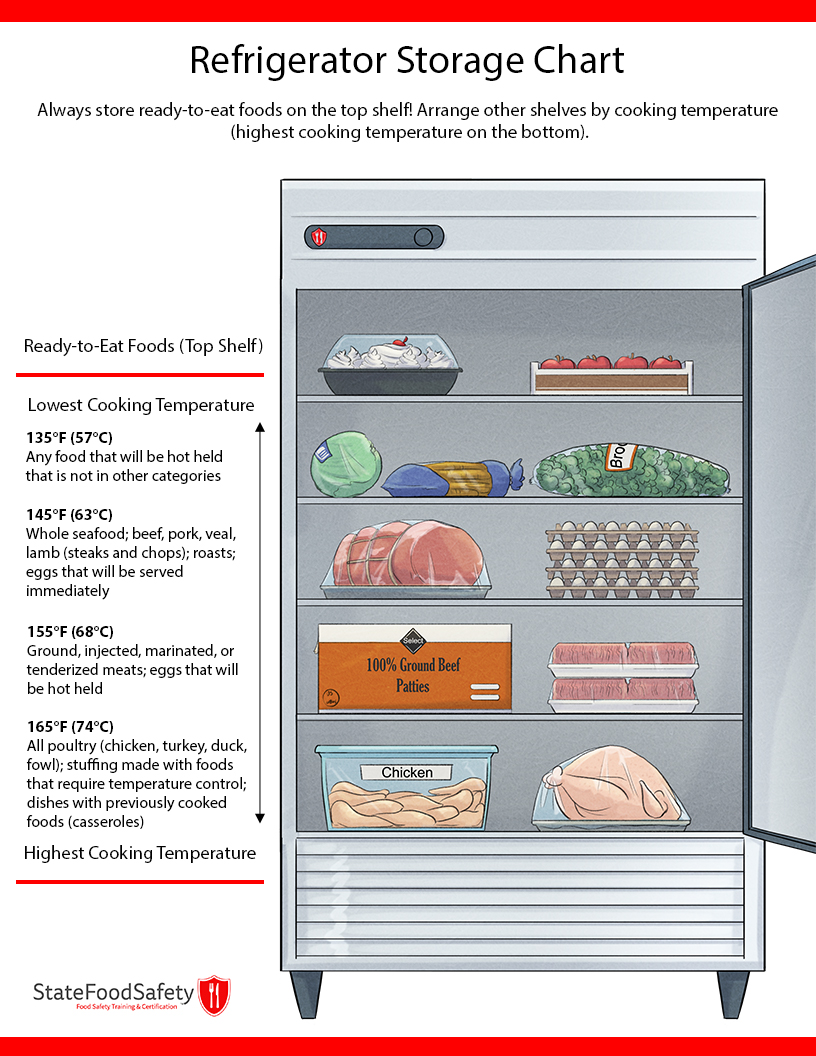
From an IoT and design perspective, the interior of your fridge is a micro-climate. Cold air sinks, and the area closest to the cooling element (usually the back) is the coldest. To prevent cross-contamination and ensure everything stays at the right temperature, you should organize your food based on its required cooking temperature.
- Top Shelf & Door: These are the warmest zones. Use the top shelf for ready-to-eat foods like deli meats, leftovers, and drinks. Contrary to popular belief, the door is the worst place for milk or eggs because it is subject to the most temperature fluctuation every time you open the fridge. Keep condiments and juices here instead.
- Middle Shelves: Ideal for dairy products (milk, yogurt, cheeses) and eggs. These items need a stable, consistent chill.
- Bottom Shelf: This is the coldest part of the fridge and the most critical for safety. This is where you store raw meat, poultry, and seafood. Storing them here prevents juices from dripping onto other foods (cross-contamination) and keeps them at the lowest possible temperature.
- Crisper Drawers: Most modern fridges have humidity-controlled drawers. Use high humidity for leafy greens that wilt and low humidity for fruits and vegetables that rot easily (like apples or mushrooms).
Maintenance Tips for Consistent Cooling
A smart home is only as smart as its maintenance schedule. Even the most expensive refrigerator will fail to hold a steady 37°F if it's struggling to breathe.
- Avoid Overcrowding: Your fridge works by circulating cold air. If you pack every shelf to the brim, you create "dead zones" where air can't reach, causing the temperature to spike in those areas. Leave at least an inch of space between items.
- Inspect Door Seals (The 'Dollar Bill' Test): Close the fridge door on a dollar bill so that half is sticking out. Try to pull it out. If it slides out easily without resistance, your gasket is loose, and you're losing cold air (and money). Clean the seals with warm soapy water or replace them if they are cracked.
- Clean Condenser Coils: At least once a year, pull your fridge out and vacuum the coils at the back or bottom. Dust buildup acts as insulation, forcing the compressor to work harder and making it difficult for the unit to maintain a safe internal temperature.
Safe Food Storage Chart: How Long Can You Keep It?
Temperature is only half the battle; time is the other. Even at a perfect 37°F, spoilage bacteria will eventually take over. Use this searchable guide to manage your inventory.
| Food Category | Refrigerator (40°F or below) | Freezer (0°F or below) |
|---|---|---|
| Raw Ground Meats | 1–2 Days | 3–4 Months |
| Raw Poultry (Whole/Parts) | 1–2 Days | 9–12 Months |
| Fresh Seafood | 1–2 Days | 3–6 Months |
| Cooked Leftovers | 3–4 Days | 2–3 Months |
| Eggs (In Shell) | 3–5 Weeks | Don't freeze |
| Bacon & Raw Sausage | 7 Days | 1–2 Months |
| Deli Meats (Opened) | 3–5 Days | 1–2 Months |
FAQ
What should I do during a power outage? Keep the door closed! A closed refrigerator will keep food safe for about 4 hours. A full freezer will maintain its temperature for 48 hours (24 hours if half-full) if the door remains shut. If the power is out longer, use a thermometer to check each item; anything above 40°F for more than two hours must be discarded.
Is it safe to put hot food directly in the fridge? Yes, but with a caveat. Large pots of hot chili or a whole roasted chicken can raise the internal temperature of the fridge, putting other items at risk. Instead, divide large amounts of food into small, shallow containers. This allows the food to cool much faster, moving it through the "Danger Zone" quickly without overtaxing your refrigerator's cooling system.
Does a colder fridge use more electricity? Technically, yes, but the difference between 40°F and 37°F is negligible on your monthly bill—usually just a few cents. The cost of a single case of food poisoning or throwing out a spoiled gallon of milk far outweighs the energy savings of running a warmer fridge.
Take Control of Your Kitchen Safety
The difference between a healthy meal and a week of illness often comes down to just three degrees. By setting your refrigerator to 37°F, verifying it with a thermometer, and organizing your shelves strategically, you’re using the best "smart" tech available: informed common sense.
Check your fridge dial today. If it's not sitting comfortably below 40°F, you're not just storing food—you're taking a risk.