Quick Facts
- Market Size: The global additive manufacturing market is projected to reach approximately $83.56 billion by 2030, representing a 21.2% compound annual growth rate.
- Maximum Scale: Current industrial capabilities allow for the production of monolithic structures up to 96 feet in length.
- Throughput Efficiency: High-output systems now achieve deposition rates exceeding 500 lbs/hr for metal and polymer applications.
- Cost Reduction: Utilizing pellet-based extrusion systems can reduce materials for large scale 3d printing costs by 60–80% compared to filament.
- Structural Benefits: Generative design and topology optimization enable up to 25% weight savings while maintaining or increasing structural integrity.
- Production Speed: Large format additive manufacturing (LFAM) can produce full-scale industrial molds in hours rather than weeks.
As we move through 2026, the question is no longer if additive manufacturing can scale, but how fast it is transforming industrial production. From 96-foot marine vessels to three-story apartment complexes, large scale additive manufacturing applications are redefining what is possible. By utilizing advanced additive manufacturing processes like Directed Energy Deposition and robotic arm fabrication, industries are moving toward monolithic components that reduce waste and accelerate timelines. Scaling additive manufacturing involves using high-throughput systems to create massive, structural parts for aerospace, construction, and maritime engineering.
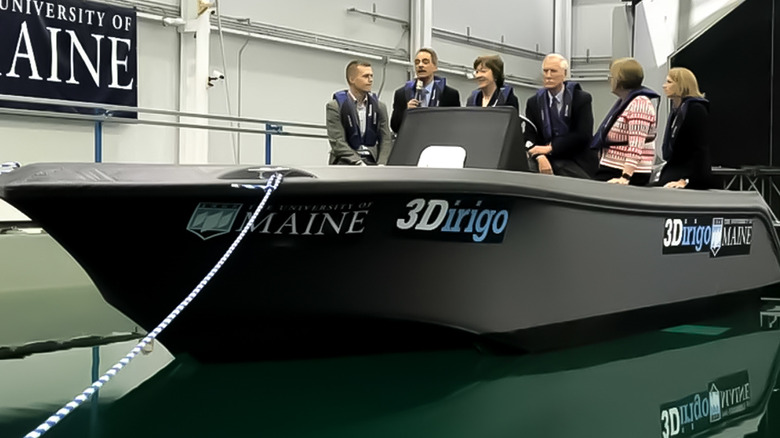
Infrastructure-Grade Proof: Massive Additive Manufacturing Examples
The validation of large-scale additive manufacturing is visible in the physical landmarks appearing across the globe in 2026. We are no longer looking at small prototypes or desktop models; we are seeing infrastructure that functions in high-stakes environments. The shift toward massive production is driven by the need for speed and the elimination of the "assembly tax"—the cost and complexity associated with joining hundreds of smaller parts.
Aerospace: Orbital Launch Vehicles
In the aerospace sector, the drive for monolithic components has reached its peak. Traditional rocket manufacturing requires thousands of individual parts, each requiring specialized tooling and inspection. Relativity Space demonstrated the power of this technology with the Terran 1 rocket, where nearly 85% of the mass was fabricated using additive manufacturing. By using massive robotic arm fabrication systems, the company printed the primary structure of the rocket in days. This approach allows for rapid iteration; if an engineer identifies a design improvement, the change can be implemented in the digital file and printed immediately, rather than waiting months for new hard tooling.

Construction: Multi-Story Living
The 3d printing for construction industry has matured significantly. In France, the ViliaSprint² project successfully delivered three-story social housing units using COBOD BOD2 Gantry printing systems. Unlike traditional masonry, which is labor-intensive and prone to material waste, these gantry systems extrude specialized concrete layers with high precision.
The benefits of using an additive manufacturing process in construction include:
- Waste Minimization: Only the exact amount of concrete needed for the structural walls is used.
- Design Freedom: Architects can incorporate curved walls and organic shapes that would be cost-prohibitive with traditional formwork.
- Integrated Utilities: Gantry systems can leave precise voids for electrical and plumbing systems, reducing post-processing time.

Maritime and Infrastructure
The 6,000 kg MX3D stainless steel bridge in Amsterdam remains a primary example of how metal additive manufacturing can solve urban infrastructure challenges. This project utilized multi-axis robotic arms to "draw" the structure in mid-air, creating a bridge that is both a functional crossing and a sensor-rich laboratory. By 2026, similar techniques are being used to create large maritime hulls and offshore energy components, where the ability to print on-site reduces the logistics of transporting massive parts.

The Technical Backbone: Metal Additive Manufacturing and DED
To achieve these massive proportions, the industry has shifted away from small-scale powder bed fusion toward more aggressive deposition methods. When we talk about additive manufacturing metal at scale, we are typically discussing Directed Energy Deposition (DED).
Directed Energy Deposition works by melting metal feedstock—either in powder or wire form—using a focused energy source like a laser, electron beam, or electric arc as it is deposited onto a surface. This method is exceptionally efficient for large industrial parts because it offers significantly higher deposition rates than other methods.
| Feature | Powder Bed Fusion (PBF) | Directed Energy Deposition (DED) |
|---|---|---|
| Build Volume | Restricted by the size of the machine's "box" | Virtually unlimited with robotic arms |
| Deposition Rate | Low (fine detail) | High (structural bulk) |
| Material Form | Fine metal powder | Metal wire or coarse powder |
| Best Application | Complex internal geometries | Large monolithic components |
Within the DED family, wire and arc additive manufacturing (WAAM) has gained significant traction for 2026 industrial projects. Because WAAM uses standard welding wire as its metal feedstock, it is far more cost-effective than systems requiring specialized metal powders. This has led to its adoption in the defense and maritime sectors for producing large-scale structural nodes and engine housings. Furthermore, the integration of 6-axis robotic arm fabrication allows these systems to print on existing curved surfaces, making them ideal for repairing large industrial equipment or adding features to pre-fabricated hulls.
Strategic Levers for Scaling: Materials and Economics
Scaling additive manufacturing is as much a financial challenge as it is an engineering one. The economics of massive production depend on two primary factors: the cost of materials and the efficiency of the design.
Material Economics
For polymer-based large scale additive manufacturing applications, the shift from filament to pellet-based extrusion has been a game-changer. Standard 3D printing filaments are processed and spooled, which adds significant cost. In contrast, pellet-based systems use the same raw plastic pellets used in injection molding. This shift typically results in 60-80% material cost savings, making it viable to print 20-foot boat hulls or architectural facades that would otherwise be too expensive.
In the metal sector, materials like Titanium alloys and Haynes® 282® are becoming the standard for high-performance aerospace components. By using an additive manufacturing process, companies can achieve a "buy-to-fly" ratio close to 1:1, meaning very little of the expensive metal feedstock is wasted. In traditional subtractive manufacturing, up to 80% of a titanium block might be machined away into scrap.
Generative Design and Optimization
To maximize the benefits of scaling, engineers use generative design and topology optimization. These software tools use algorithms to determine the most efficient placement of material based on the stresses the part will experience.
Editor's Note: Topology optimization often results in "bony" or organic-looking structures. While these are difficult to manufacture using traditional casting or milling, they are perfectly suited for additive manufacturing. This synergy allows for parts that are lighter yet possess greater structural integrity than their solid counterparts.
Decision Framework: When to Scale with AM
Not every large part should be 3D printed. By 2026, lead engineers and procurement officers use a specific framework to determine if additive manufacturing is the right choice for massive production.
- Complexity vs. Volume: Additive manufacturing is dominant for low-to-medium volume production (under 1,000 units) where the geometric complexity is high. For simple shapes at massive volumes, traditional methods may still win on a per-unit cost basis.
- Monolithic Integration: If a current assembly consists of 50 parts that must be welded or bolted together, printing them as a single monolithic component usually offers a massive ROI by eliminating assembly labor and failure points.
- Lead Time Requirements: When a replacement part for a maritime vessel or a power plant is needed immediately, the ability to print a near-net-shape component locally outweighs the cost of shipping a part from across the globe.
- Hybrid Workflows: The most successful industrial applications in 2026 often combine technologies. This involves using metal additive manufacturing to create the bulk shape of a part (near-net-shape) and then using high-precision CNC machining to finish critical surfaces like bearing seats or flange faces.
FAQ
What is meant by additive manufacturing?
Additive manufacturing is a process of joining materials to make objects from 3D model data, usually layer upon layer, as opposed to subtractive manufacturing methodologies such as traditional machining. It is the industrial term for what is commonly known as 3D printing. In a large-scale context, it involves using robotic systems or large gantries to deposit metal, plastic, or concrete to create structural components.
What are the 7 types of additive manufacturing?
The industry recognizes seven distinct categories of additive manufacturing: Vat Photopolymerization, Material Jetting, Binder Jetting, Material Extrusion, Powder Bed Fusion, Sheet Lamination, and Directed Energy Deposition. For massive industrial production, Material Extrusion (for polymers and concrete) and Directed Energy Deposition (for metals) are the most frequently utilized due to their high deposition rates and scalability.
Who are the leading brands in additive manufacturing?
The landscape is diverse, featuring companies that specialize in different niches. In the construction sector, COBOD and ICON are prominent. For aerospace and high-end metal production, Relativity Space, Nikon SLM Solutions, and Velo3D are leaders. In the large-format polymer space, companies like Cincinnati Incorporated (with their BAAM system) and Thermwood are the primary providers of the hardware used for massive industrial molds and tooling.
What is the future of additive manufacturing?
The future of the technology lies in full industrial integration and autonomous production. By the end of this decade, we expect to see "Born Qualified" components, where real-time sensor data and AI-driven monitoring during the printing process allow parts to be certified for use immediately upon completion. Additionally, the move toward multi-material printing will allow for the creation of smart structures with embedded electronics and sensors, further blurring the line between material and machine.