Quick Facts
- Status: Officially discontinued as of February 2026.
- Active Life: Less than six months from its October 2025 launch.
- Key Capability: Multi-limbed sortation capable of handling 75% of Amazon's inventory types.
- Primary Reason for Cancellation: High manufacturing costs and a strategic pivot toward the "Orbital" warehouse model.
- Future Direction: Transitioning from bespoke hardware to AI-driven software optimization (DeepFleet).
- Projected Impact: Amazon still aims to automate 75% of operations by 2027, saving $0.30 per processed item.
The tech world moves fast, but the life cycle of Amazon’s Blue Jay warehouse robot was a literal blink in the history of industrial automation. Launched with massive fanfare in October 2025, the multi-armed mechanical marvel was hailed as the "extra set of hands" that would finally solve the complexity of stowing and picking diverse items. Yet, by February 2026, the project was quietly shelved.
The abrupt cancellation wasn't a sign of technical failure—Blue Jay worked remarkably well. Instead, it was a ruthless executive decision driven by the reality of "hardware friction" and a massive $200 billion reallocation of capital toward generative AI and flexible software systems. Amazon is no longer interested in building better robots; they are interested in building a smarter warehouse "brain" that requires less rigid hardware to function.
The Rise and Sudden Fall of Blue Jay
When Blue Jay was first unveiled, it represented the pinnacle of Amazon’s robotics division. It was the result of an intensive one-year development cycle, made possible by "Digital Twin" technology that allowed engineers to simulate millions of hours of operation before a single bolt was tightened. It was designed to fill a specific gap: while previous robots like Robin or Sparrow were good at moving specific bins, Blue Jay was meant to act as a universal consolidator.
However, the transition from the laboratory to the messy, high-velocity environment of a fulfillment center proved more difficult than expected. While it only took a year to build, it survived only six months in the field. The reason? The "Blue Jay" was an expensive solution to a problem Amazon decided to solve through structural architecture rather than mechanical dexterity. The robot was shelved not because it couldn't pick up a bottle of shampoo, but because Amazon found a cheaper way to move that shampoo using the new "Orbital" system.
What Was Blue Jay? The 'Extra Set of Hands'
Blue Jay was a multi-limbed sortation system designed to bridge the gap between human dexterity and robotic speed. Unlike its predecessors, which often featured a single arm with limited reach, Blue Jay utilized a sophisticated array of sensors and multiple articulating limbs to pick, stow, and consolidate items of various shapes, weights, and textures.
The technical ambition was staggering. Amazon’s goal was for Blue Jay to handle roughly 75% of all item types stored across its facilities. This included everything from soft apparel and oddly shaped electronics to heavy pantry staples. By acting as a literal "extra set of hands," the robot was intended to work alongside employees, taking over the repetitive, ergonomically taxing tasks of item sortation.
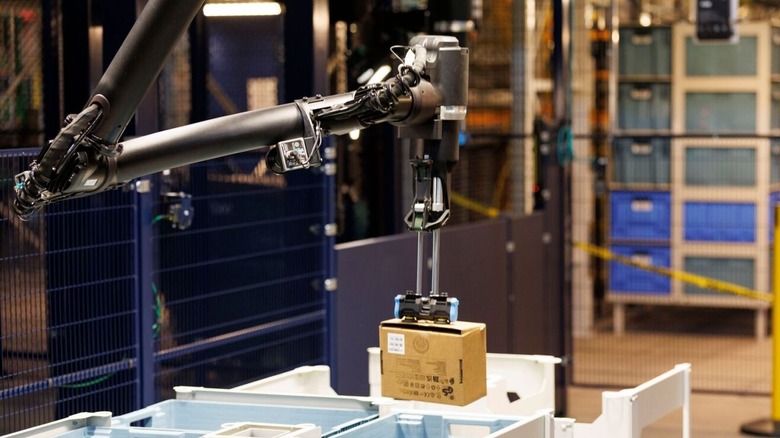
The use of Digital Twins was the secret sauce that brought Blue Jay to life so quickly. By creating a 1:1 virtual replica of the robot and its environment, Amazon could refine its "hand-eye" coordination in a virtual space. This allowed the robot to achieve a level of precision in six months that would have taken five years for the older "Robin" arm to master.
The Real Reason: Cost vs. Scalability
If the technology worked, why kill it? The answer lies in the brutal math of global logistics. While Blue Jay was a mechanical masterpiece, it was also a "bespoke" piece of hardware. Every unit was expensive to manufacture, and more importantly, expensive to maintain.
- Bespoke Hardware Hurdles: Unlike modular conveyor belts, Blue Jay required specialized parts and highly trained technicians to keep its multi-limbed systems calibrated.
- Integration Friction: The robot was designed for a world where humans and machines share the same floor space. However, fitting a high-speed, multi-armed robot into a legacy warehouse designed for people created bottlenecks. The "human-centric" workflow actually slowed the robot down, negating the efficiency gains.
- The $200 Billion Pivot: In early 2026, Amazon announced a massive $200 billion increase in AI spending. This capital wasn't coming from thin air; it was being clawed back from capital-intensive hardware projects. Leadership decided that investing in "smarter" software was more scalable than building thousands of "heavy" robots like Blue Jay.
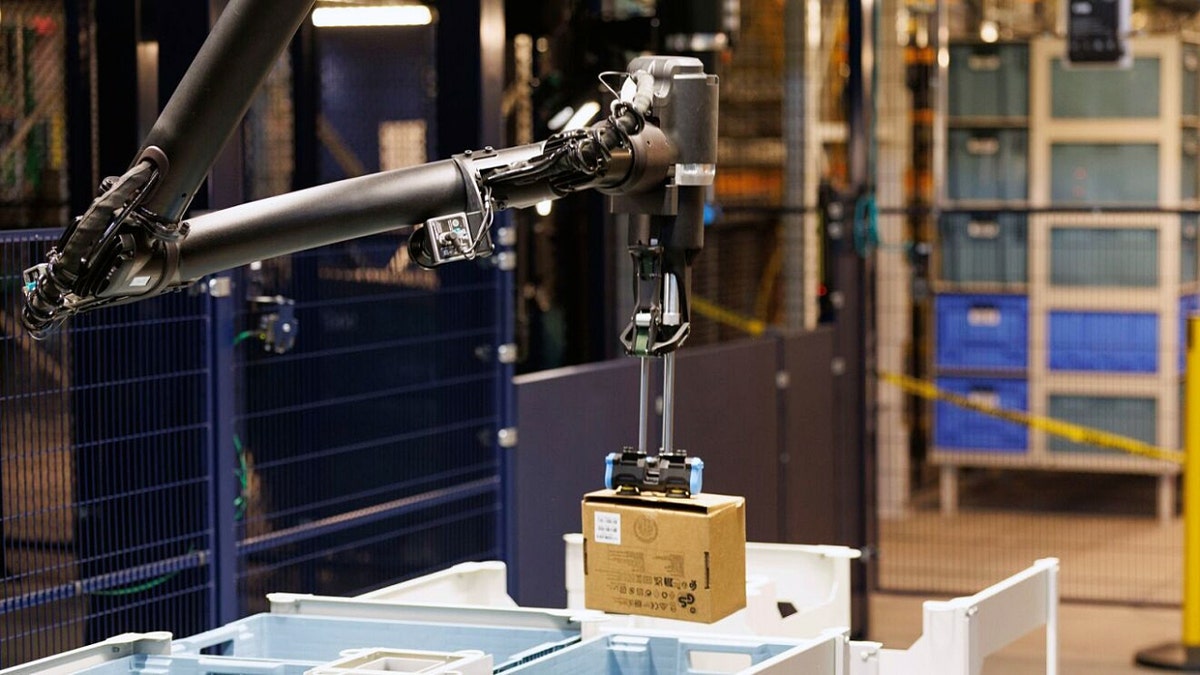
Essentially, Blue Jay became a victim of its own complexity. At a time when Amazon is looking to save 30 cents on every item processed, a robot that costs hundreds of thousands of dollars to install and requires a team of engineers to monitor simply didn't fit the balance sheet.
The 'Orbital' Shift: From Vending Machines to Malleable Hubs
The shelving of Blue Jay marks the end of what insiders call the "Local Vending Machine" (LVM) model. For years, Amazon’s strategy was to build warehouses that functioned like giant, automated vending machines—fixed structures where robots brought bins to people.
The new direction is Orbital. This is a flexible, reconfigurable warehouse model specifically designed for the demands of same-day delivery. Instead of large, fixed robotic cells like the one Blue Jay inhabited, Orbital uses "malleable hubs." In this model, the warehouse floor can be reconfigured in hours, not weeks.
| Feature | Old Model (LVM) | New Model (Orbital) |
|---|---|---|
| Primary Goal | Storage density | Fulfillment speed (Same-day) |
| Hardware | Fixed, bespoke (e.g., Blue Jay) | Modular, floor-based (e.g., Proteus) |
| Software | Hard-coded logic | AI-driven (DeepFleet) |
| Flexibility | Low (hard to change layout) | High (reconfigurable in real-time) |
While Blue Jay as a physical unit is gone, its "brain" is being recycled. The computer vision and grasping logic developed for Blue Jay are being integrated into the Flex Cell and Orbital platforms. Amazon is effectively taking the intelligence out of the expensive body and putting it into a more flexible, software-defined system.
The 2026 Automation Labor Shift
The cancellation of Blue Jay is a key milestone in what analysts are calling the "2026 Automation Labor Shift." This isn't just about replacing one robot with another; it's a fundamental change in how Amazon views its workforce and its technology stack.
Amazon is shifting focus from hardware to DeepFleet, a sophisticated AI software that acts as a fleet optimizer. DeepFleet doesn't just tell a robot where to go; it predicts inventory flow and reconfigures the entire warehouse layout on the fly. This transition has led to the elimination of over 100 specialized roles within the robotics division, specifically those tied to bespoke hardware development.
The long-term goal remains aggressive:
- Operational Goal: Automate 75% of all warehouse tasks by 2027.
- Labor Impact: A projected reduction in hiring needs by 160,000 people over the next two years.
- Economic Impact: A targeted savings of $0.30 per item processed, which is critical for maintaining margins on low-cost, same-day delivery items.
Beyond Blue Jay: The Rest of the Robotic Fleet
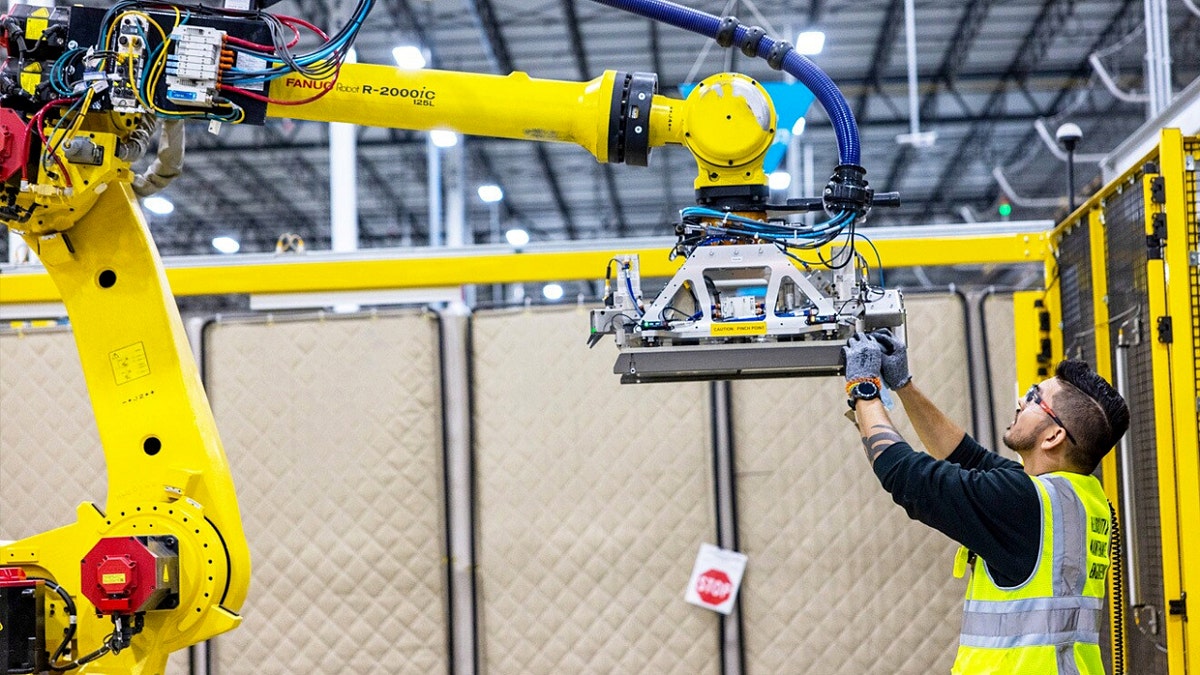
The death of Blue Jay doesn't mean Amazon is giving up on robotics. In fact, it's narrowing its focus to robots that are either more modular or more specialized. The "survivors" of the 2026 budget cuts are robots that can adapt to the Orbital system's fluidity.
One such survivor is Vulcan. Unlike Blue Jay, which was a stationary sortation powerhouse, Vulcan is a two-armed robot designed with a literal "sense of touch." Using haptic sensors and advanced computer vision, Vulcan can feel the difference between a fragile glass jar and a sturdy box, adjusting its grip in real-time.
Amazon is also moving away from fixed-track systems in favor of floor-based, autonomous mobile robots (AMRs). These units can move anywhere in the warehouse, making them much more compatible with the "malleable hub" philosophy than a massive, fixed installation like Blue Jay.
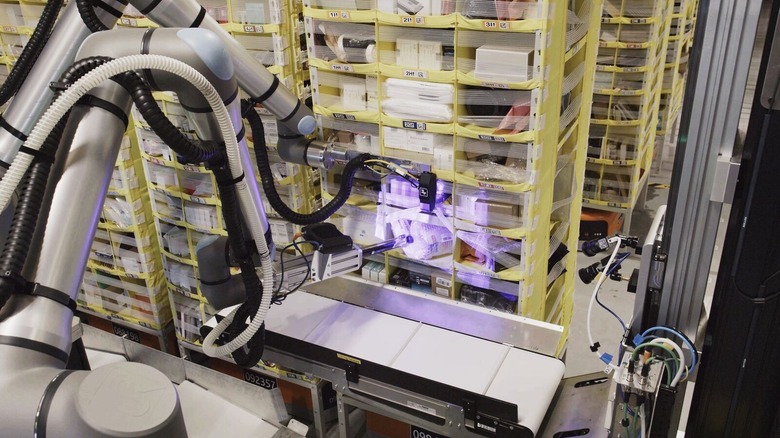
The story of Blue Jay is a classic example of "fail fast." Amazon spent a year building a masterpiece, realized within six months that the world had changed, and had the corporate will to scrap it in favor of a more scalable future. Blue Jay might be gone, but its DNA is already being written into the software that will run the warehouses of 2027.
FAQ
Q: Did Blue Jay fail because it couldn't pick up items? A: No, the robot was technically successful and could handle 75% of Amazon's inventory. It was shelved due to high manufacturing costs and a strategic shift toward more flexible, software-driven warehouse models.
Q: What is the 'Orbital' system that replaced the Blue Jay model? A: Orbital is Amazon's new warehouse architecture focused on same-day delivery. It prioritizes "malleable hubs" and modular robots over fixed, bespoke hardware installations like the Blue Jay.
Q: Will there be more layoffs in Amazon's robotics division? A: While Amazon eliminated over 100 roles specifically tied to the Blue Jay project, they are simultaneously hiring for AI software roles to support the DeepFleet system. The shift is more about changing the type of talent needed rather than a total exit from robotics.
Is the era of heavy warehouse robotics over? The shelving of Blue Jay suggests that Amazon is pivoting toward "intelligence over iron." If you're following the future of logistics, the move toward the Orbital system is the clearest signal yet that the next revolution won't be in how robots look, but in how they think.