For any seasoned traveler, the sounds of the road are a familiar symphony. There is the steady hum of the engine, the rhythmic click of the turn signal, and—all too often—the jarring, bone-shaking rattle of a tire drifting onto a shoulder rumble strip. In the industry, we call this "haptic feedback." It is the infrastructure’s way of screaming at a drowsy or distracted driver to wake up before a momentary lapse becomes a terminal mistake.
According to data from the Federal Highway Administration (FHWA), nearly 50% of fatal crashes on U.S. highways involve lane departures. This sobering statistic has led civil engineers to adopt a "Safe System" approach—an engineering philosophy that anticipates human error rather than merely punishing it. At the heart of this safety net are rumble strips: a low-cost, high-impact intervention that uses vibrotactile pavement systems to save lives. However, for decades, the safety benefits of these strips have been a double-edged sword, pitted against the auditory comfort of the surrounding communities.
Today, we are witnessing a quiet revolution in highway engineering. The transition from traditional rectangular rumble strips to sinusoidal "mumble strips" represents a sophisticated balance between public safety and acoustic environmentalism.
Understanding the Basics: Traditional Rectangular Strips
The traditional rumble strip is a blunt instrument of safety. Typically "milled-in" to the asphalt, these strips consist of a series of rectangular or cylindrical grooves, usually 7 inches wide and 12 to 16 inches long. When a vehicle’s tire passes over these depressions, the sudden drop and subsequent impact against the back edge of the groove create two distinct effects: a physical vibration (the tactile alert) and a sharp, loud noise (the auditory alert).
While undeniably effective, the traditional design suffers from what engineers often call the "Sledgehammer Effect." The impact of the tire hitting the sharp edges of the rectangular groove produces a high-decibel bark that can travel for miles, especially in quiet, rural corridors.
For residents living near highways, schools, or protected parks, this "safety sound" is often perceived as a significant form of noise pollution. In some jurisdictions, the community pushback against the noise has been so severe that departments of transportation (DOTs) have been forced to remove the strips or forgo their installation entirely, leaving drivers without a vital safety net. This conflict created the engineering mandate for a quieter alternative.
The Sinusoidal Revolution: What is a 'Mumble Strip'?
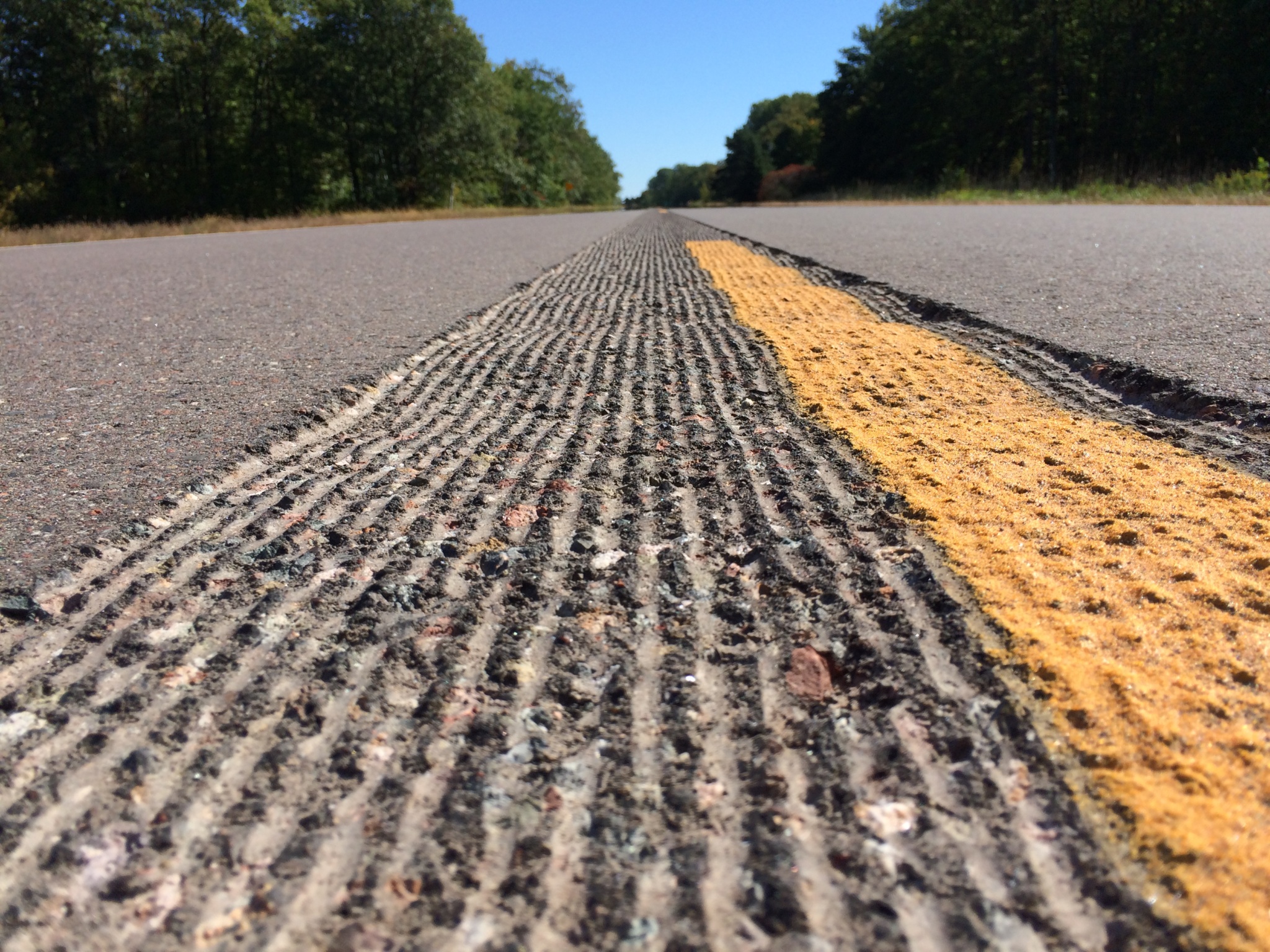
The solution to the noise conflict lies in geometry. Unlike the sharp, cliff-like drops of traditional rectangular strips, sinusoidal rumble strips utilize a continuous, wave-like pattern (a sine wave) carved into the pavement. Because of the subdued sound profile they produce outside the vehicle, they have earned the colloquial nickname "mumble strips."
The fundamental difference lies in the tire-pavement interaction. In a sinusoidal design, the tire follows a smooth, oscillating path of troughs and crests. Instead of a violent "strike" against a vertical edge, the tire experiences a gradual change in elevation. This subtle shift in geometry is enough to maintain the necessary vibration within the cabin while drastically reducing the external noise broadcast to the surrounding environment.
Engineering specifications for these strips are precise. Most modern designs utilize a 14-inch wavelength, with depths ranging from 1/8 to 1/2 inch. By modulating the frequency of the wave, engineers can "tune" the road to provide the exact level of haptic feedback required to alert a driver without creating a nuisance for the neighborhood.
Noise Reduction: Solving the Community Conflict
The primary metric for evaluating mumble strips is the decibel (dB) reduction. Research indicates that sinusoidal rumble strips reduce external sound levels by 3 to 7 decibels compared to standard rectangular designs. To a layperson, 3 to 7 decibels might sound negligible, but because the decibel scale is logarithmic, a 3 dB reduction represents a 50% decrease in sound energy.
Where should sinusoidal rumble strips be installed? While traditional strips are still suitable for remote interstates with no nearby residents, sinusoidal strips are specifically recommended for:
- Rural two-lane highways where homes are situated close to the roadway.
- Areas near noise-sensitive receptors, such as schools, hospitals, and national parks.
- Residential zones where speed limits exceed 35 mph, but noise ordinances are strict.
By implementing mumble strips, engineers effectively eliminate the "not in my backyard" (NIMBY) argument against road safety. We no longer have to choose between a quiet night's sleep for a resident and a life-saving alert for a distracted driver.
Safety Effectiveness: Do Mumble Strips Save Lives?
The most critical question for any safety critical infrastructure is whether the quieter design compromises the core mission: crash prevention. The data suggests that it does not.
Research from the FHWA and various state DOTs shows that the implementation of shoulder rumble strips correlates with a 36% reduction in the frequency of run-off-road crashes. This is known as the Crash Modification Factor (CMF), a vital metric used by planners to justify infrastructure spending.
For a rumble strip to be effective, it must provide a "wake-up call" that exceeds the ambient noise inside the vehicle. For a drowsy driver, an interior sound differential of 6 to 12 dB over the baseline cabin noise is generally required to trigger an immediate corrective response. Sinusoidal strips are engineered to hit this "sweet spot." They maintain the necessary vibrotactile warnings to the steering wheel and floorboards, ensuring the driver feels the danger even if the external world barely hears a hum.

Engineering & Implementation Guidelines
Deploying rumble strips is not as simple as milling grooves into any available surface. There are several structural and safety parameters that must be met to ensure the longevity of the road and the safety of all road users, including cyclists.
| Feature | Traditional Rectangular | Sinusoidal (Mumble) |
|---|---|---|
| Geometry | Blunt, vertical edges | Smooth, wave-like oscillations |
| External Noise | High (75-85+ dB) | Low (68-75 dB) |
| Interior Vibration | Intense/Abrupt | Smooth/Consistent |
| External Noise Reduction | Baseline | 3 to 7 dB Reduction |
| Best Application | Remote Interstates | Rural Highways / Residential Proximity |
Key Implementation Requirements:
- Speed Thresholds: Rumble strips are generally most effective on roadways with speeds exceeding 35 mph. At lower speeds, the tire does not generate enough centrifugal force to produce a clear tactile alert.
- Bicycle Safety: For cyclists, rumble strips can be a hazard. Engineering guidelines now require "gaps" in the strips (typically 10-12 feet of striping followed by a 4-6 foot gap) to allow cyclists to safely move between the shoulder and the travel lane.
- Pavement Integrity: Strips should only be milled into pavements in good condition. Milling into aged, brittle asphalt can lead to accelerated delamination and pothole formation.
- Retroreflective Synergy: In many modern projects, the rumble strip is milled directly into the fog line (the white line on the shoulder), and the line is then painted over the grooves. This creates a "rumble stripe," which enhances nighttime visibility during rain, as the vertical faces of the grooves reflect headlights better than flat pavement.
Future Trends: Digital Twins and Smart Infrastructure
As we look toward the next decade of road safety, the physical engineering of the pavement is merging with digital oversight. We are moving away from reactive maintenance toward a proactive, data-driven model.
One of the most exciting developments is the use of Digital Twins and AI-driven monitoring. By using drone imagery and high-resolution LiDAR scans, departments of transportation can create digital replicas of their highway networks. This allows engineers to monitor the degradation of rumble strips in real-time. If the depth of a sinusoidal wave decreases due to pavement wear, AI algorithms can flag the section for maintenance before its safety effectiveness drops below critical thresholds.

Furthermore, we are preparing for the era of Autonomous Vehicles (AVs). While human drivers need sound and vibration to stay alert, AVs rely on sensors. Future "smart roads" may see sinusoidal patterns designed not just for human haptics, but as localized "barcodes" that AV sensors can read to confirm lane positioning in poor visibility conditions where cameras might fail. This synchronization of physical haptics and digital sensing will create a multi-layered safety net for both manual and autonomous driving.

Frequently Asked Questions (FAQ)
Are sinusoidal rumble strips more expensive to install than traditional ones? Initially, the cost was slightly higher due to the specialized milling heads required to create the sine-wave pattern. However, as the technology has become more standardized, the price gap has narrowed significantly. When considering the "social cost" of noise complaints and the potential for legal challenges from residents, sinusoidal strips are often the more cost-effective long-term solution.
Do mumble strips work in snow and ice? Yes. In fact, rumble strips (both traditional and sinusoidal) can help drivers identify the edge of the road when snow cover obscures pavement markings. However, they do require careful plowing; snowplow blades can occasionally catch on deep grooves, though the smooth profile of sinusoidal strips actually makes them slightly more "plow-friendly" than rectangular designs.
Can sinusoidal rumble strips be added to existing roads? Absolutely. This process is called "retrofitting." As long as the shoulder width is sufficient (typically at least 4-5 feet for bicycle safety) and the pavement is in stable condition, a milling machine can be used to add sinusoidal patterns to existing highways.
Conclusion
The evolution from traditional rumble strips to sinusoidal "mumble strips" is a testament to the sophistication of modern civil engineering. It proves that we do not have to sacrifice community peace for the sake of public safety. By leveraging the physics of sound and the geometry of a wave, we have created an invisible safety net—one that speaks loudly to the driver while whispering to the world outside.
As we continue to integrate AI and smart infrastructure into our transit networks, the humble road groove will remain a cornerstone of the "Safe System" approach. For the traveler, it remains a silent guardian, ensuring that a moment of fatigue doesn't end a journey prematurely.